IFAC World Congress 2026 in Busan 参加紀行
参加日記
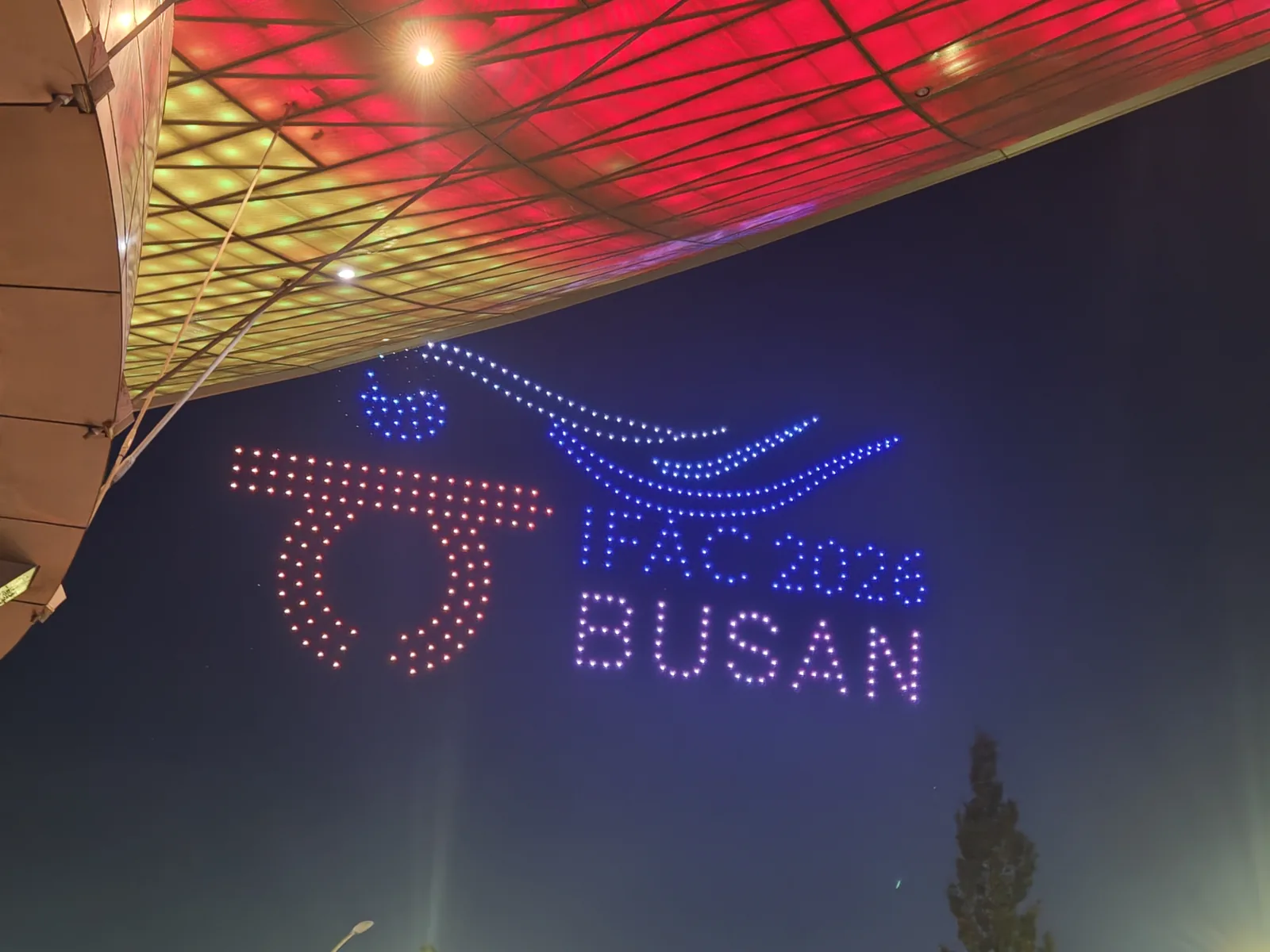
IFAC World Congress 2026 in Busan 参加紀行
1. 座長席と追憶のAgricontrol2025
去年の夏,筆者はカリフォルニアの発表席で,座長の質問が聞き取れず,存在しない質問に回答した。英語であることは分かった。英語であること以外が分からなかった。その顛末はIFAC Agricontrol 2025 in Davis 参加紀行に書いた通りである。
それから一年。2026年8月23日から28日にかけて,韓国・釜山で開催された第23回IFAC World Congressに参加した。今回も発表者である。ただし今回は,あの質問が飛んできた側の席,つまり座長席にも座ることになった。
セッションのco-chairに指名されていると判明したのは,会期の一月ほど前である。発表だけでも緊張するのに,セッション運営まで背負うことになった。まさか一年後に自分があっち側に座るとは思っていなかった。本稿は,座長席と発表席の両方から見たWorld Congressの記録である。
2. World Congressとは何か
IFAC(International Federation of Automatic Control)が何かという話は,去年の紀行で一通り書いたので省略する。同じ話を二度書くと,筆者の限られた語彙が先に枯渇する。一点だけ繰り返すと,IFACは分野ごとのTechnical Committee(TC)の集合体であり,去年参加したAgricontrolは農業における制御を扱うTC 8.1の分科会であった。
では今回のWorld Congress(WC)とは何か。一言で言えば,IFACの本体でありフラッグシップ会議である。
WCは3年に1度開催される。第1回は1960年のモスクワにまで遡り(この大会でかの有名なKalman Filterの原型が提案されたとか),以来60年以上にわたって世界中を巡回してきた。前回の第22回は2023年,日本・横浜での開催であった。そして今回の第23回が,釜山のBEXCO(Busan Exhibition and Convention Center)である。
Agricontrolのような分科会とは打って変わり,WCには全てのTCが一堂に会する。制御と名の付くあらゆる分野の研究者が,数千人規模で一つの会場に集結する。制御工学のオリンピックと言ってよい。当然,農業の分科会はその中の一角に過ぎない。
3. IFAC World Congressという未知数
筆者にとって今回が初のWCである。そして参加を決めた時点では,WCがどんなものかまったく想像がついていなかった。
Agricontrolであれば,近い分野の研究者が集まるため,似た研究をしている人が会場にいることは想像がつく。一方WCでは,農業セッションは広大なプログラムの片隅にあり,聴衆の大半は農業の門外漢である。トラクタの遠隔操作という筆者の研究は,そこでどう受け取られるのか。そもそも誰か聞きに来るのか。TC 8.1のセッションはいくつあるのか。何も分からないまま,とにかく論文を出してみた,というのが実情である。
発表したのは「Effects of Delay on the Teleoperation of Agricultural Robots」と題した研究である(Morita et al., 2026)。農業ロボットを遠隔操作したとき,通信遅延が増えると操作の挙動がどう変わるかを調べたもので,繰り返し試験と被験者内のt検定で論じている。白状すると,統計解析はもっと厳密にやる必要があった。この「もっと厳密に」という宿題は,のちにジャーナル論文として回収されることになるのだが,それはまた別の話である。
ミュンヘン開催のAgricontrol2022(筆者にとっての初投稿)で「English is poor」とはねられて以来,査読コメントとは開く前に一呼吸置くものになった。いつまで経っても慣れるものではないのかもしれない。
結果として,採択であった。しかも査読コメントには,自動化が進む農業においてこそ遠隔操作が重要になる,という筆者の主張に対して,時代に即した重要な研究であるという前向きな評価が並んでいた。「English is poor」から二年でここまで来た。素直に嬉しかった。
4. 釜山と冷麺
8/22まで北海道大学150周年の式典で東京で実演展示を行い,そのまま韓国に飛んだ。成田空港からのフライトであったが,千葉県で地震や豪雨がちょうど直撃しており,正直かなり焦っていたが,無事に飛んだ。今回はソウル近くの仁川国際空港ではなく,釜山の金海国際空港に直接飛び,8/23に釜山入りした。ちなみに帰りのフライトは金海国際空港から成田空港へ向かう便であったが,大韓航空の荷物預けが混雑極まっており,荷物を預けるのに90分近く並んだ。出発の3時間前に空港へ到着したにも関わらず,かなりギリギリだった。正直システムや導線がめちゃくちゃ悪いので,金海国際空港から出発する際は気をつけられたい。
釜山は想像の5倍は都会だった。まずビルの高さがいちいちあり得ない。地震は大丈夫なのだろうか。そして交通量がやばい。暑い。と思いきや,ビル街の隣にいきなりビーチがあり,これが海雲台というエリアで,会場のBEXCOもこの近辺であった。移動はほぼ全てUberを使った。捕まえるのも容易だし,タクシー料金が日本の半額程度で大変移動がしやすかった。
食事については,平壌冷麺が美味かった。海雲台エリアのプダミョノクという店で,ミーハーだが,ミシュラン掲載という安心感に負けて入った。負けてよかった。また,趣が無いことにマクドナルドとスターバックスに入り浸っていた。しかしチェーンと侮ることなかれ,メニューが日本とはかなり異なっており,これはこれで新鮮であった。
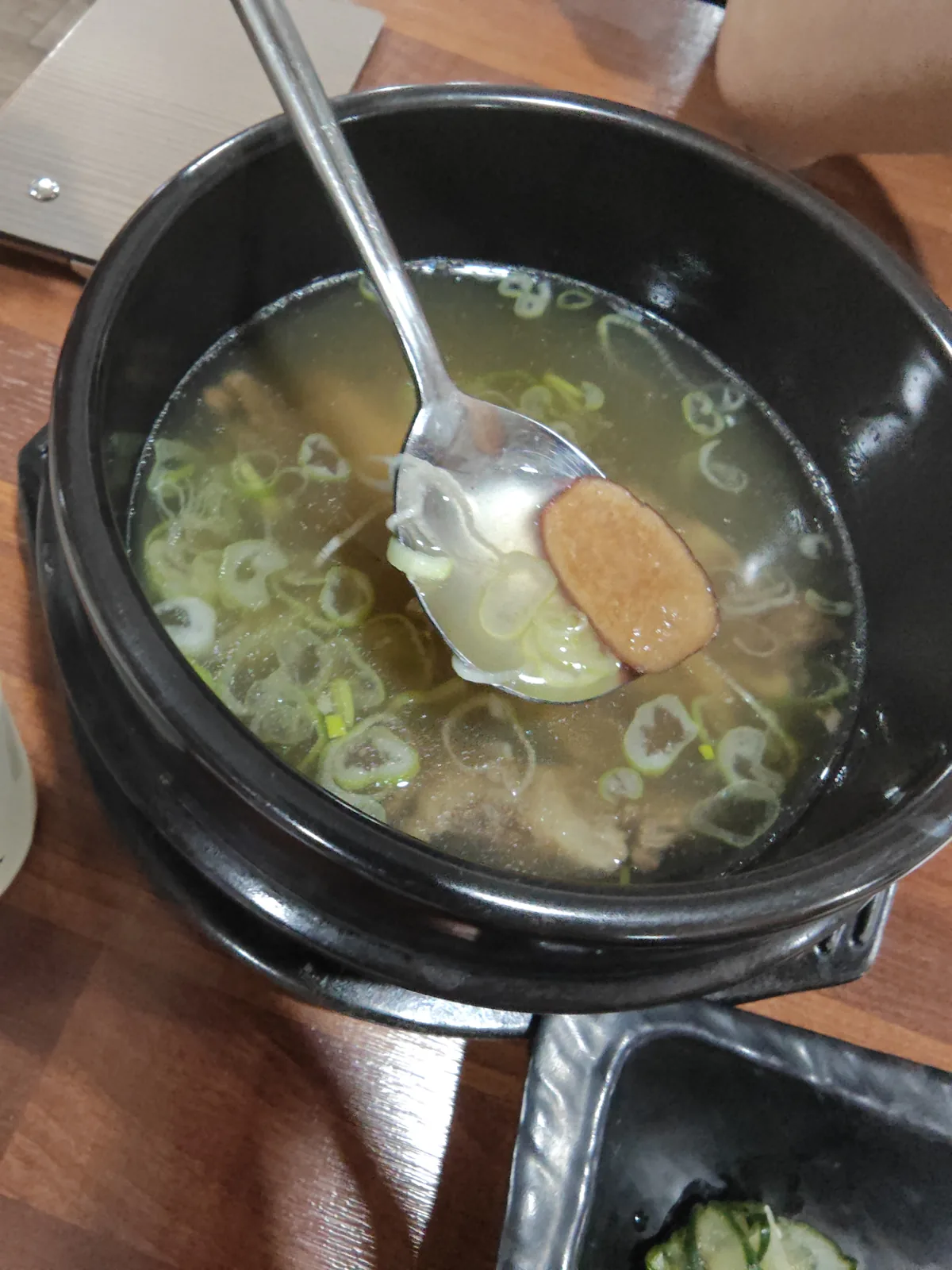
旅情については,日本語が無いこと以外は日本とあまり変わらないと感じてしまった時点で,筆者に語る資格がない。釜山の魅力は他の参加者の紀行に譲る。
5. 毎日英語,そして研究者タイプという偏見
今回の筆者には,密かな追い風があった。日曜に釜山入りしてから木曜の本番まで,中国人ポスドクの同僚と毎日英語で喋り散らかしていたのである。研究の話から他愛のない雑談まで,来る日も来る日も英語であった。日本語を全く使っていなかった。人間,追い込まれた環境で毎日話していると,この短期間でも劇的にパワーアップするもので,会期の後半には英語が口から出ることへの抵抗がほとんど消えていた。
その雑談の中で,一つ印象に残った話がある。研究者のあるべき形,というか,これからどんな研究をしていくのか,という話である。
彼の視点では,研究者にはいろいろなタイプがいるが,粗く分けると,ビジネスマンタイプと好奇心タイプの2つに分けられる。そして基本的に評価されるのは前者である。ここまではお互いに異論がなかった。
その中でも,彼の意見では,日本は決してアカデミアにお金があるタイプの国ではないし,論文競争もアメリカや中国ほど厳しくない。それなのに一定数のノーベル賞や面白い人が現れるのは,好奇心タイプを放牧させていた時代の名残ではないか。また,中国では好奇心タイプはあまり生き残れないという。成果が出るまで時間がかかるからである。適度な競争は必要だが,論文数などのKPIが強すぎて,それに順応するかどうかのゲームになっている。本人たちも好奇心があるというより,有名になり影響力を持つために流行りの研究をやっている。もし他の流行が来たら,簡単にそちらへ移るだろう,というのが彼の観察であった。
どちらが正しいという話ではない。身も蓋もないがバランスが大事である。しかしながら,好奇心タイプはコネクションを作らなくてよい,という話にもならない。これは筆者の持論だが,どちらのタイプであれ,研究を話せるライバルであり友である存在は,世界中にいたほうがよいと思う。他にもトップ研究者の動向やそれとの差がわからなくなると,やることが内向きになりすぎてしまう。それが良い場面もあるかもしれないが,多くの場合そうではないことが多い。
他にも,彼の故郷の話や,故郷では日本のマスコットが非常に人気だという他愛のない話までした。雑談をする時間は意外と研究室ではないので,好きなものや大事にしている矜持など,新たな一面が見えて,こういった時間の使い方も大事にしていきたいと強く感じた。
6. 当日
当日,自分の発表はというと,力説しすぎて時間をオーバーしそうになり,途中でかなり切り上げた。座長自ら時間管理にザルな姿勢を見せてしまった。一応TC8.1のメンバー以外も来ているか?ということから,遠隔運転における遅延の重要性を説いたつもりである。むだ時間が線形な位相遅れを引き起こすという事象は,制御屋なら大好物だろうとの見立てであった(?)。
幸い質疑では三つほど質問が来て,今回はどちらも聞き取れた。一つ目は,使用したネットワークの詳細である。「プライベート5G」だと答えた。日本では「ローカル5G」と呼ぶが,この呼び方は国際的には一般的ではないのかもしれない。どちらかというと,プライベート5Gの方が伝わると思っていたが,あまりピンと来ている感じでもなかった。続けて,ネットワークが切れたときのフェイルセーフはどうなっているか。これには,コネクションは常時観測されており,切れたときには自動的に停止する,と答えた。二つ目は,UDPだとパケットロスが起こるがどう対処しているか。パケットロスが起きるとブロックノイズが生じて映像品質が落ちる,だからこそ映像品質の許容量といった主観的な研究も重要になる,と答えた。
質問者が回答に満足したかはやや怪しい。しかし少なくとも,存在する質問に答えることはできた。イマジナリークエスチョンへの回答を試みた去年からすれば,大きな進歩である。
かすり傷で自身の発表を終えた。発表を終え,後半のセッションは私が担当することになる。たどたどしくも,プレゼンターとプレゼンについて紹介する。ここまでは順調である。
しかし,事件は質疑で起きた。フロアから質問が出なかったのである。しかも二度。会場に沈黙が流れる。co-chairたる筆者は,ここで一肌脱ぐことにした。自ら質問を投げたのである。
座長席では,発表を聞きながら懸命に質問をひねり出していた。座っているだけなら落ち着いて見えるかもしれないが,頭の中までそうとは限らない。
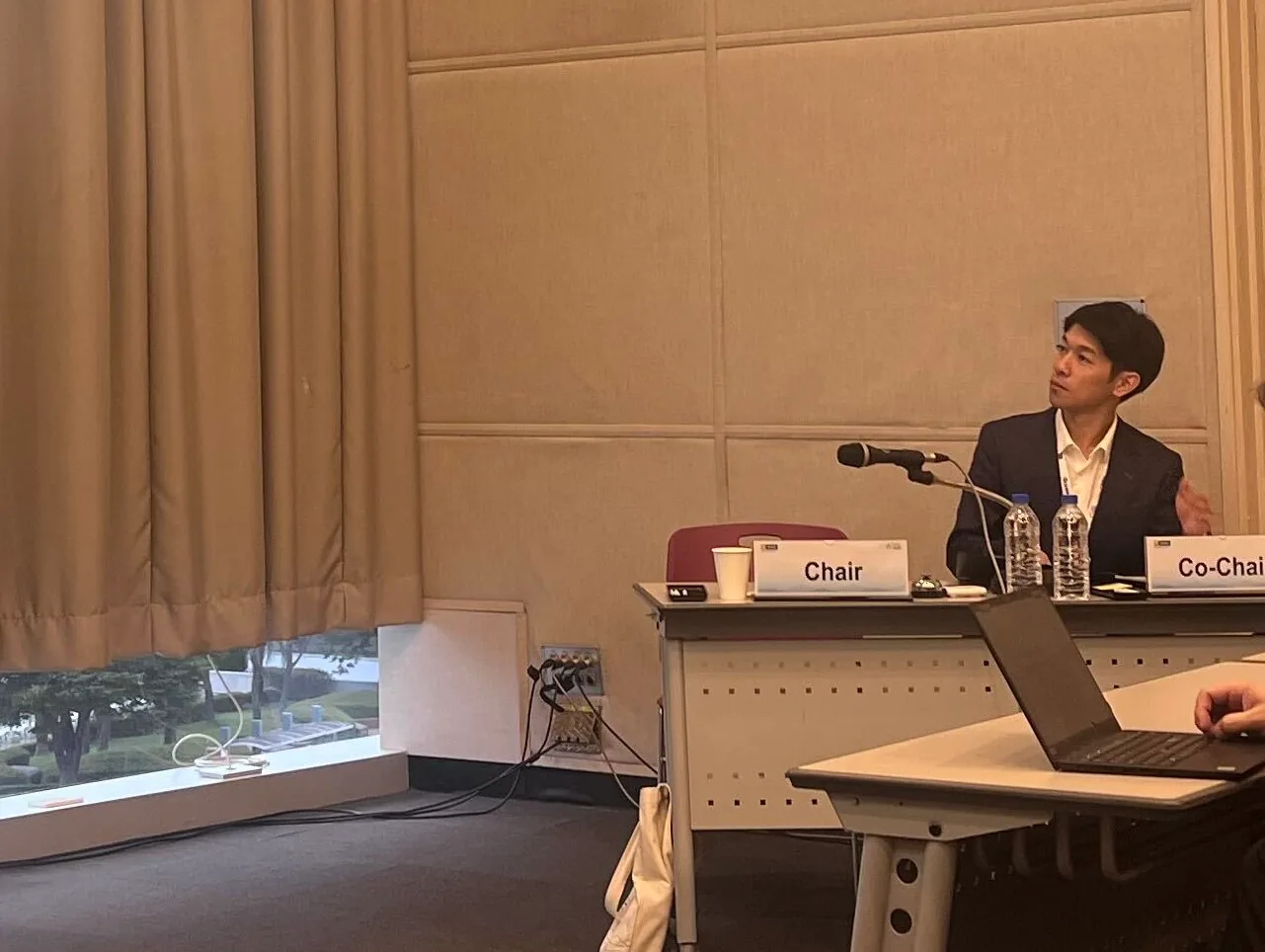
一度目は,リンゴ収穫ロボットのスループット低下に関する発表であった。そもそも何が原因でスループットが落ちるのか。アームの経路計画の問題なのか,収穫の失敗なのか,支配的な要因は何かを聞いた。プレゼンターは内訳のグラフまで出してくれて,アームの経路が障害物などを避ける際に経路計画が難しくなりがちということについて非常に丁寧に答えてくれた。
二度目は,UAVとUGVの連携に関する発表であった。筆者が知りたかったのは,UAVが一度の飛行でミッションを作ってUGVに渡すのか,それとも飛行中にリアルタイムで情報を修正する機構があるのか,という点である。ところが,前提が間違っていたのか,英語が悪かったのか,あるいはその両方か,発表者との間に噛み合わない気まずい時間が流れた。座長席で味わう気まずさは,発表台で味わうそれとはまた別の趣がある。
ただし今回の筆者は,あらかじめ「恥」という単語や概念を頭から消し去って会場入りしていた。存在しない概念を感じることはできない。したがって傷は浅かった。国際会議を生き延びる技術として,お勧めしたい。
総括すると,同じセッションのchairであったTechnical University of Munich (TUM)のTimo Oksanen先生が大変優しくしてくださったおかげで,運営自体は快調であった。今後も会議でお会いする機会があると思うので,これがよいつながりに育ってくれると嬉しい。
7. 技術セッションとポスターを眺めて
ポスター会場を歩いていて印象的だったのは,発表がかなり理論寄り,それもマルチエージェントシステム的な制御に大きく寄っていたことである。古典制御かつSISOシステムで扱う研究は,ほとんど見かけなかった。もはやその領域でやることはあまり残っていない,ということなのだろう。制御の最前線は,多数のエージェントが協調する系と,その理論の側へ移っているように見えた。さらに言えば,ほとんどの研究が機械学習を使う方向にシフトしており,制御とは言うものの中身は機械学習とロボット制御,というのが潮流なのだろう。かくいう筆者は数式の壁の前で,分かったような顔で頷きながら「入力が複数で出力が単一ならMISOか」などと考えていた。門外漢の思考とはこの程度である。
その中で印象に残ったのは,TUMのTimo Oksanen先生のグループの発表である。砂塵のある状態で,画像だけを頼りに環境認識を行うというものであった。農業機械の周囲は,土埃や砂で視界が悪くなることが日常的にある。センサを増やして解くのではなく,画像だけでどこまでやれるかを攻めるという設定が面白かった。論文も出ているらしい(Buckel et al., 2026)。
他にも,同じくTUMの発表で,トラクタを実データから作業機を含む系のプラントとして推定するという研究をしていた。非常に古典的でいぶし銀だと思った。システム同定としてどこが新しいかはあまり理解できなかったが,筆者は遠隔運転という系において,コントローラとなる人が未知という問題に直面しがちなので,機会があればこうしたシステム同定と遠隔操作を組み合わせた研究も面白そうだ。
8. バンケット
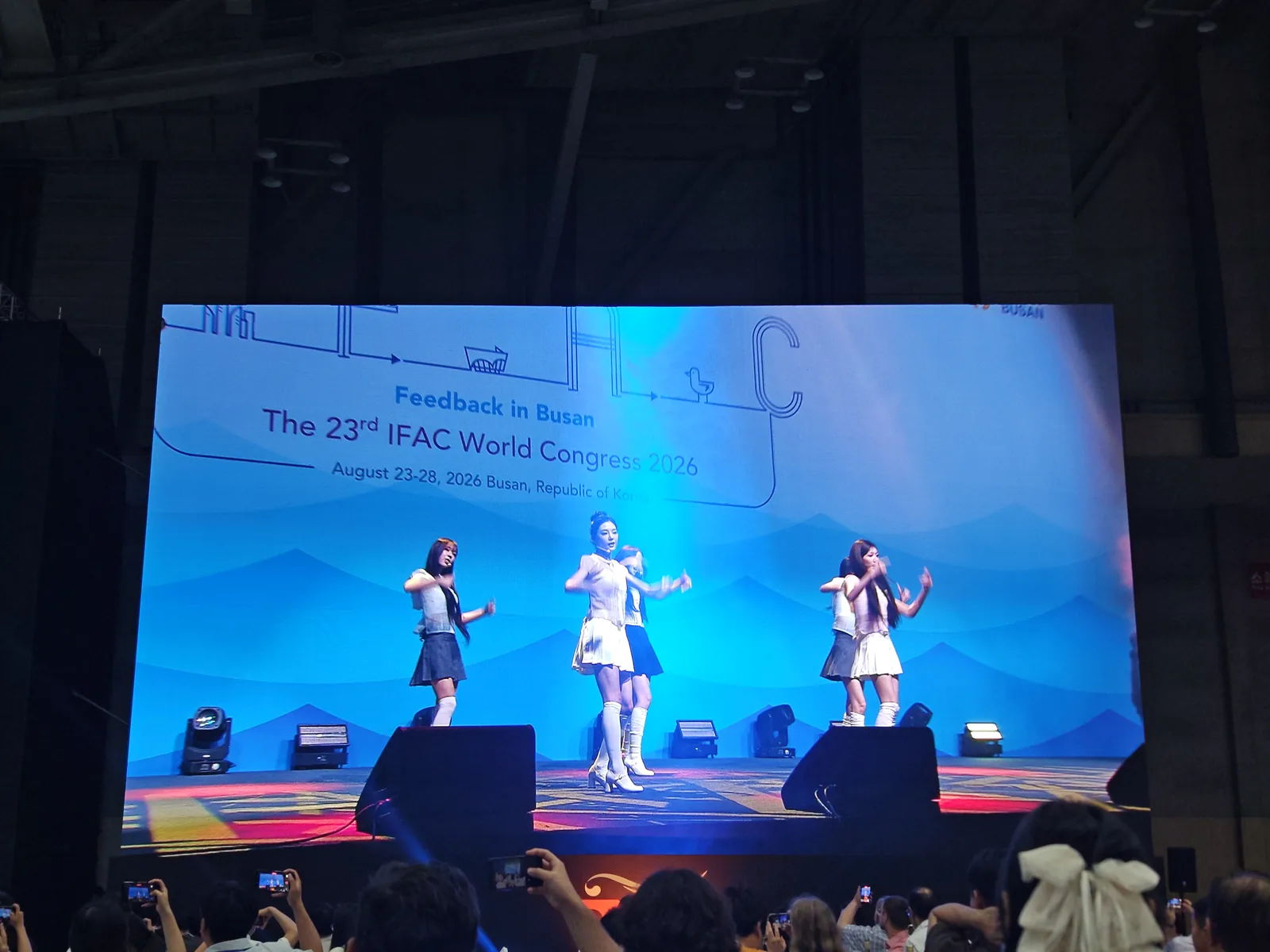
バンケットは,コース料理の形式であった。去年のAgricontrolで,バンケットとは論文の向こう側にいる著者たちが兜の緒を緩めながらざっくばらんに語り合う場である,と学んだ筆者は,今回もコネクション作りを目論んで臨んだ。が,WCのバンケットは勝手が違った。会場にいるのは制御のあらゆる分野の研究者である。隣に座った人が,農業どころかロボットとも無縁である確率がかなり高い。共通の話題という取っ掛かりがないまま,他分野の研究者と関係を築くのは難しかった。ちなみにダンスパフォーマンスなども豪華に用意されていて,本当にお金がかかっているなと感じた。
IFACのロゴを背にダンスが繰り広げられる光景は,なかなかシュールであった。昼間は制御理論の話を聞いていたはずなのに,夜には同じロゴの前でダンスを見ている。
9. IFAC Control Orchestra
クロージングセレモニーでは,IFAC Control Orchestraという企画が披露された。公式ページ(IFAC 2026, n.d.)によれば,control theoryの原理と音楽演奏を融合させる画期的な試みであり,制御工学の原理の実践的応用をオーケストラ音楽によって示すものである,とのことである。何を言っているのか分からないが,とにかく本気らしい。
指揮者はYoonhak Baek氏。ソウル大学で電気工学の学位を取得し,ソウル・フィルハーモニーで指揮の経験を積んだという,工学と音楽の両方を背負った人物である。楽団はほぼ研究者で構成されているらしい。制御への愛を感じた。
10. 振り返って
WCは面白かった。ただ,他分野の発表を見て勉強になった,という感じでは特段なかった。門外漢には分野の壁が高すぎた。一方で規模は桁違いである。あらゆる制御の研究者が一つの会場に集まるお祭り感は分科会にはないもので,一度体験しておく価値がある。
そのお祭りの中で自分の論文が採択されたことは,単純に嬉しい。そして筆者のように分科会を主戦場とする人間にとっては,自分たちがIFACというコミュニティの一員として認知され始めている,とも読める。切磋琢磨する同業のライバルたちが今何をしているのかを定点観測する場としても,また出てみたいと思う。
そして今回は,co-chairという役回りまで経験できた。恥の概念を消し,気まずい時間を生き延びた。「English is poor」と殴られていた頃の筆者からすれば,結果はどうあれ座長席から英語で質問を投げているというだけで,大きな成長である。
次の予定として,2027年にTC8.1とIEEEのジョイントで新しい会議を立ち上げるらしく,初回にはぜひ出たい。次のAgricontrolは2028年なので,そちらにも継続して出したい。ただ,会議に出るだけでは足りない。会議論文で溜まった宿題を,そろそろジャーナル論文に回収していかなければならない。座長席に座れるようになった以上,次に殴られるとすれば,その査読結果である。
参考文献
- Morita, T., Sonoki, T., Yamauchi, T., Yokota, M., Yamagishi, K., & Noguchi, N. (2026). Effects of Delay on the Teleoperation of Agricultural Robots. 23rd IFAC World Congress, Paper ThB24.2. IFAC WC 2026 official program
- Buckel, P., Dietmüller, T., & Oksanen, T. (2026). A dataset for investigating dust removal for person detection. Computers and Electronics in Agriculture, 253, 112141. https://doi.org/10.1016/j.compag.2026.112141
- IFAC 2026 (n.d.). IFAC Control Orchestra. https://www.ifac2026.org/fairContents.do?FAIRMENU_IDX=22511&hl=ENG (閲覧日: 2026-09-16)
IFAC World Congress 2026 in Busan Participation Journal
1. The Chair's Seat, and a Memory of Agricontrol 2025
Last summer, I stood at a podium in California. I could not catch the session chair’s question, so I answered a question that did not exist. I knew it was English. That was all I knew. I wrote about it in IFAC Agricontrol 2025 in Davis Participation Journal.
One year later, from August 23 to 28, 2026, I attended the 23rd IFAC World Congress in Busan, Korea. Again I was a presenter. But this time I also sat on the other side: the chair’s seat, where that question came from.
I learned that I had been assigned as a session co-chair about a month before the congress. Presenting alone is stressful enough. Now I also had to run a session. I never expected to be on that side just one year later. This article is a record of the World Congress seen from both the chair’s seat and the podium.
2. What Is the World Congress?
I explained what IFAC (International Federation of Automatic Control) is in last year’s journal, so I will skip it here. If I write the same story twice, my limited vocabulary will run out first. One point is worth repeating: IFAC is a collection of Technical Committees (TCs), one per field. Agricontrol, which I attended last year, is the workshop of TC 8.1, which covers control in agriculture.
So what is the World Congress (WC)? In one sentence, it is the main body of IFAC and its flagship conference.
The WC is held once every three years. The first one was in Moscow in 1960 (I heard the early form of the famous Kalman Filter was presented there). Since then it has traveled around the world for more than 60 years. The previous one, the 22nd, was held in Yokohama, Japan in 2023. This 23rd one was held at BEXCO (Busan Exhibition and Convention Center) in Busan.
Unlike a workshop such as Agricontrol, the WC brings all TCs together in one place. Researchers from every field with “control” in its name gather in one venue, thousands of them. You could call it the Olympics of control engineering. Naturally, the agricultural workshop is only a small corner of it.
3. The World Congress, an Unknown Quantity
This was my first WC. When I decided to join, I had no idea what the WC would be like.
At Agricontrol, researchers from close fields gather, so I can expect people doing similar work to be there. At the WC, the agricultural sessions are a small corner of a huge program, and most of the audience are outsiders to agriculture. How would my research on tractor teleoperation be received there? Would anyone even come to listen? How many TC 8.1 sessions would there be? I knew nothing. I just submitted a paper anyway. That is the honest story.
The paper I presented was “Effects of Delay on the Teleoperation of Agricultural Robots” (Morita et al., 2026). It studies how operation behavior changes as communication delay increases when an agricultural robot is teleoperated. It uses repeated trials and a within-subject t-test. To be honest, the statistical analysis should have been more rigorous. That homework, “be more rigorous”, was later picked up as a journal paper. But that is another story.
Since my first submission, to Agricontrol 2022 in Munich, was rejected with “English is poor”, I always take a breath before opening reviewer comments. Maybe you never get used to it.
The result was acceptance. Moreover, the reviewer comments were positive. They agreed with my claim that teleoperation becomes more important, not less, as agriculture becomes automated, and called it an important and timely study. From “English is poor” to this in two years. I was simply happy.
4. Busan and Cold Noodles
Until August 22, I was in Tokyo giving a live demonstration at the 150th anniversary ceremony of Hokkaido University. From there I flew straight to Korea. The flight was from Narita Airport. An earthquake and heavy rain hit Chiba Prefecture just then, and I was quite worried, but the flight left safely. This time I flew directly to Gimhae International Airport in Busan, not Incheon near Seoul, and arrived on August 23. By the way, my return flight was from Gimhae to Narita, and the Korean Air baggage drop was hopelessly crowded. I stood in line for nearly 90 minutes just to hand over my suitcase. I had arrived three hours before departure, and it was still a close call. Frankly, the system and the flow of the queues are a mess. If you fly out of Gimhae, be careful.
Busan was five times more urban than I imagined. First, the buildings are unbelievably tall, every one of them. Are they safe in earthquakes? And the traffic is wild. And it is hot. Then, right next to the high-rise area, there is suddenly a beach. This area is Haeundae, and BEXCO is near it. I used Uber for almost all my travel. Rides were easy to catch, and fares are about half of those in Japan, so getting around was very easy.
As for food, the Pyongyang-style cold noodles were excellent. The restaurant was Budaemyeonok in the Haeundae area. It is a bit trendy of me, but I gave in to the safety of a Michelin listing. I am glad I gave in. I also, unglamorously, spent a lot of time at McDonald’s and Starbucks. But do not look down on chains. The menus were quite different from Japan, and that was fresh in its own way.
On the travel mood itself: the moment I felt that Busan was not so different from Japan except for the lack of Japanese, I lost the right to talk about it. I leave the charm of Busan to other participants’ journals.
5. English Every Day, and a Prejudice About Researcher Types
I had a quiet tailwind this time. From Sunday, when I arrived in Busan, until my presentation on Thursday, I talked in English every day with a Chinese postdoc colleague. Research talk, small talk, everything, day after day, in English. I did not use Japanese at all. When you are pushed into such an environment, you improve dramatically even in a short time. By the second half of the congress, my resistance to speaking English had almost disappeared.
One topic from those chats stayed with me. It was about what a researcher should be, or rather, what kind of research to do from now on.
In his view, there are many types of researchers, but roughly they split into two: the businessman type and the curiosity type. And the ones who get evaluated are basically the former. We both agreed up to this point.
He went further. Japan is not a country with a lot of money in academia, and the paper competition is not as harsh as in the US or China. Yet Japan still produces a certain number of Nobel prizes and interesting people. He thinks this is a leftover from the era when curiosity-type researchers were allowed to roam free. In China, he said, the curiosity type does not survive well, because results take time. Some competition is needed, but KPIs such as paper counts are so strong that it becomes a game of whether you adapt to them. The researchers themselves are not so much curious; they do trendy research to become famous and influential. If another trend came along, they would easily move to it. That was his observation.
It is not a question of who is right. It is a blunt thing to say, but balance matters. And it does not mean the curiosity type can skip building connections. This is my own view: whichever type you are, it is better to have rivals-and-friends around the world with whom you can talk about research. Also, once you lose track of what the top researchers are doing and how far behind you are, your work turns too inward. There may be moments when that is good. In most cases it is not.
We also talked about his hometown, and about trivial things like how popular Japanese mascots are there. In the lab, there is surprisingly little time for small talk. Through these chats I saw new sides of him, such as what he likes and what he takes pride in. I strongly felt that this kind of time is worth keeping.
6. The Day
On the day, my own presentation ran long because I got too passionate, and I had to cut it short midway. The chair himself showed a loose attitude toward time management. Since people from outside TC 8.1 might be in the room, I tried to make a case for why delay matters in teleoperated driving. My guess was that a dead time causing a linear phase lag is exactly the kind of thing control people love (?).
Luckily, about three questions came in the Q&A, and this time I could hear all of them. The first was about the details of the network we used. I answered, “private 5G”. In Japan we call it “local 5G”, but that term may not be common internationally. I thought “private 5G” would be clearer, but the questioner did not seem fully convinced either. The follow-up was about the fail-safe when the network drops. I answered that the connection is monitored at all times, and the robot stops automatically when it is lost. The second question was about packet loss with UDP and how we handle it. I answered that packet loss causes block noise and lowers video quality, and that is exactly why subjective studies, such as how much video quality degradation is acceptable, are important.
Whether the questioners were satisfied is a bit doubtful. But at least I answered questions that existed. Compared to last year, when I tried to answer an imaginary question, this is big progress.
I finished my own presentation with only scratches. After that, the second half of the session was mine to run. Haltingly, I introduced each presenter and their talk. So far, so good.
But the incident happened in the Q&A. No questions came from the floor. Twice. Silence filled the room. As co-chair, I decided to step up. I asked the questions myself.
In the chair’s seat, I was listening to the presentations while desperately trying to come up with questions. Sitting there might make me look calm, but that does not necessarily extend to what is going on in my head.
The first was a presentation on throughput drop in an apple harvesting robot. I asked what causes the throughput to drop in the first place: is it the arm’s path planning, or harvest failures, and which factor is dominant? The presenter even pulled up a breakdown chart and explained very carefully that path planning tends to get hard when the arm has to steer around obstacles.
The second was a presentation on UAV-UGV cooperation. What I wanted to know was whether the UAV builds a mission in one flight and hands it to the UGV, or whether there is a mechanism to update information in real time during the flight. But maybe my assumption was wrong, or my English was bad, or both. An awkward, unconnected exchange with the presenter followed. Awkwardness in the chair’s seat has a different flavor from awkwardness at the podium.
However, this time I had erased the word and concept of “shame” from my mind before entering the venue. You cannot feel a concept that does not exist. So the wound was shallow. I recommend this as a survival skill for international conferences.
All in all, Prof. Timo Oksanen of the Technical University of Munich (TUM), who chaired the same session, was very kind, and the session itself ran smoothly. I expect to meet him at future conferences, and I hope this grows into a good connection.
7. Technical Sessions and Posters
Walking through the poster hall, I was struck by how theoretical the presentations were, and how strongly they leaned toward multi-agent-system-style control. I saw almost no work on classical control with SISO systems. Perhaps there is not much left to do in that area. The front line of control seems to have moved toward systems of many cooperating agents and their theory. Furthermore, most work has shifted toward machine learning. It is called control, but the content is machine learning plus robot control. That seems to be the trend. As for me, I stood in front of a wall of equations, nodding as if I understood, thinking things like “multiple inputs and a single output, so that is MISO”. That is the level of an outsider’s thinking.
Among them, the presentation from Prof. Timo Oksanen’s group at TUM stayed with me. It was about environment perception using images alone under dusty conditions. Around agricultural machines, visibility is often reduced by dust and sand. Instead of adding sensors, they push how far images alone can go. I found that problem setting interesting. A paper is out as well (Buckel et al., 2026).
Another TUM presentation estimated the plant of a tractor with its implement from real data. Very classical, quietly impressive work. I could not fully understand what was new as system identification. But in teleoperation, I often face the problem that the controller is a human, an unknown. If I get the chance, combining this kind of system identification with teleoperation could be interesting research.
8. The Banquet
The banquet was a course dinner. At last year’s Agricontrol, I learned that a banquet is where the authors behind the papers loosen up and talk openly. So this time too I came planning to make connections. But the WC banquet was different. The people in the room were researchers from every field of control. The person next to you is quite likely to have nothing to do with agriculture, or even robots. Without a shared topic to start from, building relationships with researchers in other fields was hard. By the way, there were lavish dance performances and the like as well. Someone clearly spent real money on this.
Watching dancers perform in front of the IFAC logo was rather surreal. I had spent the day listening to control theory, and now I was watching a dance show in front of the same logo.
9. IFAC Control Orchestra
At the closing ceremony, a program called the IFAC Control Orchestra was performed. According to the official page (IFAC 2026, n.d.), it is a groundbreaking attempt to fuse the principles of control theory with musical performance, demonstrating practical applications of control engineering principles through orchestral music. I do not know what that means, but they seemed serious.
The conductor was Mr. Yoonhak Baek, who holds a degree in electrical engineering from Seoul National University and gained conducting experience with the Seoul Philharmonic. He carries both engineering and music. The orchestra was reportedly made up mostly of researchers. I felt their love for control.
10. Looking Back
The WC was fun. But I did not especially feel that I learned a lot from presentations in other fields. The walls between fields were too high for an outsider. On the other hand, the scale is on another level. The festival feeling of every control researcher gathering in one venue is something a workshop does not have. It is worth experiencing once.
Having my paper accepted at that festival is simply pleasing. And for someone like me, whose main battlefield is the workshop, it can also be read as a sign that we are starting to be recognized as members of the IFAC community. As a place to regularly check what my rivals in the same field are doing, I would like to attend again.
And this time, I also experienced the role of co-chair. I erased the concept of shame and survived the awkward moments. Compared to the me who was being hit with “English is poor”, just throwing a question in English from the chair’s seat, whatever the result, is big growth.
As for what comes next, TC 8.1 and IEEE are apparently launching a new joint conference in 2027, and I want to be at the first one. The next Agricontrol is in 2028, and I want to keep submitting there too. But attending conferences is not enough. It is time to turn the homework piled up from conference papers into journal papers. Now that I can sit in the chair’s seat, the next thing to hit me will be those review results.
References
- Morita, T., Sonoki, T., Yamauchi, T., Yokota, M., Yamagishi, K., & Noguchi, N. (2026). Effects of Delay on the Teleoperation of Agricultural Robots. 23rd IFAC World Congress, Paper ThB24.2. IFAC WC 2026 official program
- Buckel, P., Dietmüller, T., & Oksanen, T. (2026). A dataset for investigating dust removal for person detection. Computers and Electronics in Agriculture, 253, 112141. https://doi.org/10.1016/j.compag.2026.112141
- IFAC 2026 (n.d.). IFAC Control Orchestra. https://www.ifac2026.org/fairContents.do?FAIRMENU_IDX=22511&hl=ENG (Accessed: 2026-09-16).